Parim vs. Connecteam: Which workforce management software is better for your business?
This article compares Parim vs Connecteam to help you find the best workforce management tool for your team. We'll be providing an in-depth coverage of features, pricing, compliance, and scalability.
Both Parim and Connecteam provide workforce management tools for scheduling, time tracking, payroll, and operational oversight. While the two systems share a significant amount of overlapping functionality, each also offers features that are better suited to different industries and use cases. Connecteam focuses on general workforce management, whereas Parim supports broader workforce needs while also providing purpose-built tools for security teams and live event operations. The following comparison examines how these differences impact day-to-day operations.
How we evaluated: Our insights and conclusions come from hands-on testing of each platform’s free trial by our experienced team.
Parim is a modern, cloud-based workforce management platform for shift-based teams, with industry-specific features for security teams and live event operations. It combines core workforce functionality, including advanced scheduling, pay and charge rates, absence tracking, and comprehensive client and subcontractor management, with mission-critical security features such as check calls, incident reporting, asset tracking, SIA badge checker, and dedicated event scheduling – perfect for event security teams, live events, including catering, concert management teams etc.
Connecteam is a general-purpose workforce management platform designed for managing deskless employees. It provides tools for scheduling, time tracking, internal communication, HR management, onboarding and training. While the platform does not offer industry-specific features out of the box, its high level of customization allows many shift-based teams to tailor it to their needs. However, some industries may require additional specialized tools, which would need to be purchased separately.
Parim
Connecteam
Example pricing
Starts from $47/month for the Starter plan
$29/month per hub; most teams require all 3 hubs ($87/month) for up to 30 users
Unlimited users
Yes, unlimited users included in all plans
No, plans include up to 30 users; additional users incur extra costs
Billing approach
Based on scheduled hours, not headcount
Based on number of users and number of hubs
Onboarding cost & approach
Free onboarding with dedicated account managers, plus self-learning materials
Primarily self-service onboarding with extensive resources (videos, academy hub, webinars)
Contract flexibility
Monthly or annual plans available
Monthly or annual plans available
Free trial / demo
Free 14-day trial available
Free 14-day trial available
Best suited for
Teams with fluctuating or scaling workforce sizes
Teams with a more fixed headcount
Parim uses a scheduled-hours pricing model with unlimited users included across plans, which makes it easier to scale up teams without paying more for every additional guard, supervisor, subcontractor, or client user. That’s often a better fit operations where staffing levels change week to week or season to season, and where you need many users in the system (including clients or subcontractors) but want costs tied to operational volume.
Connecteam offers transparent, structured pricing based on the number of users and selected hubs, with plans starting at $29 per hub per month. Most teams will likely require all three hubs to access full functionality, bringing the starting cost to $87 per month. Each plan includes up to 30 users, with additional costs applied as headcount grows. With monthly or annual plans, a 14-day free trial, and primarily self-service onboarding supported by extensive learning resources. Connecteam’s pricing model is well suited to organisations with a fixed or predictable workforce size.
Fill shifts quicker than ever. Unlimited free users.
Parim uses a scheduled-hours pricing model with unlimited users included across plans, which makes it easier to scale up teams without paying more for every additional guard, supervisor, subcontractor, or client user. That’s often a better fit operations where staffing levels change week to week or season to season, and where you need many users in the system (including clients or subcontractors) but want costs tied to operational volume.
Connecteam offers transparent, structured pricing based on the number of users and selected hubs, with plans starting at $29 per hub per month. Most teams will likely require all three hubs to access full functionality, bringing the starting cost to $87 per month. Each plan includes up to 30 users, with additional costs applied as headcount grows. With monthly or annual plans, a 14-day free trial, and primarily self-service onboarding supported by extensive learning resources. Connecteam’s pricing model is well suited to organisations with a fixed or predictable workforce size.
Pros and Cons
While both platforms deliver essential workforce management capabilities, the specifics of their functionality make them better suited to different types of operations and organisational priorities.
Parim
✅ Pros
Agile scheduling and complete time & attendance
Managers can quickly build and update schedules, plan weeks or months ahead in minutes, manage absences, and spot attendance issues at a glance – all from a single system.
Strong reporting & compliance capabilities
Parim provides a wide range of built-in reports, including shift coverage, time clock activity, absences, position coverage, revenue, employee insights, action history, and checkpoint tours, giving managers clear operational visibility.
Native features for physical security and live event teams
Parim includes purpose-built tools for security and event operations, helping teams avoid juggling multiple systems and unnecessary costs. Features such as event and temporary project management, check calls, asset tracking, SIA badge checking, and incident reporting are all available natively within the platform.
❌ Cons
Less onboarding and training functionality
While Parim provides basic onboarding support, such as an initial onboarding form for new employees, it offers fewer built-in training and learning tools. In comparison, Connecteam includes more extensive onboarding and training features: customisable forms, a knowledge centre, and the ability to create quizzes and courses from scratch.
Less focus on HR and internal communication features
Parim excels in operational control and security-specific workflows, but teams that prioritise HR processes, employee engagement, or internal communication may find these areas less comprehensive
Connecteam
✅ Pros
High level of customisation
Connecteam offers strong customisation across onboarding and daily workflows, including configurable forms, quizzes, and training courses built from scratch. System sections can be renamed to match your organisation’s terminology, and individual features can be assigned or restricted by role, giving managers and administrators granular control over access and responsibilities.
Modern and sleek UI
Connecteam features a clean, modern interface that is intuitive and visually well structured across both desktop and mobile. The design makes it easy for employees to navigate schedules, clock in and out, complete tasks, and access information with minimal training
Ease of use
Designed for quick rollout, Connecteam is well suited for teams that prioritise simplicity and standard workforce workflows. With guided setup, self-service configuration, and clear user journeys, organisations can get up and running quickly without lengthy implementation or complex system configuration.
❌ Cons
Limited support for security and event-specific operations
Even though Connecteam allows the creation of checkpoint tours via NFC tags, it still lacks native functionality: event scheduling, check calls, asset tracking, and shift-linked incident reporting, SIA badge checker (UK market) that are often crucial for these industries.
Restricted operational controls
Inability to bulk-edit timesheets, run reports based on actual hours worked, ban staff from specific sites, or provide admin mobile access can create manual workarounds for security teams.
Use Cases
Parim is best for:
Teams with complex operational and pay structures
Well suited for teams with higher operational demands and complex pay and charge structures, Parim supports bulk actions across scheduling and timesheets, along with advanced pay and billing rules for staff and clients, such as rates based on staff age, day of the week, or other custom conditions.
Physical security operations requiring compliance and accountability Well suited for guarding companies that rely on check calls, incident reporting, asset tracking, and audit-ready records to meet client and regulatory requirements.
Teams managing live events and temporary projects Ideal for organisations that need to rapidly staff events, manage short-term or one-off projects, handle fluctuating headcounts, and manage clients and subcontractors.
Connecteam is best for:
General workforce management needs Well suited for organisations that need straightforward scheduling and time tracking, alongside support for broader HR processes.
Companies prioritising onboarding, training, and internal communication A good choice for teams that need structured onboarding, knowledge sharing, quizzes, company events, courses, rewards alongside day-to-day workforce coordination.
Healthcare businesses that require HIPAA compliance
Suitable for healthcare organisations that must manage staff scheduling and communication while meeting HIPAA compliance requirements, ensuring sensitive employee and operational data is handled securely.
Parim vs Connecteam: Essential Features Comparison
Shift Scheduling and Time Tracking – Winner: Tie
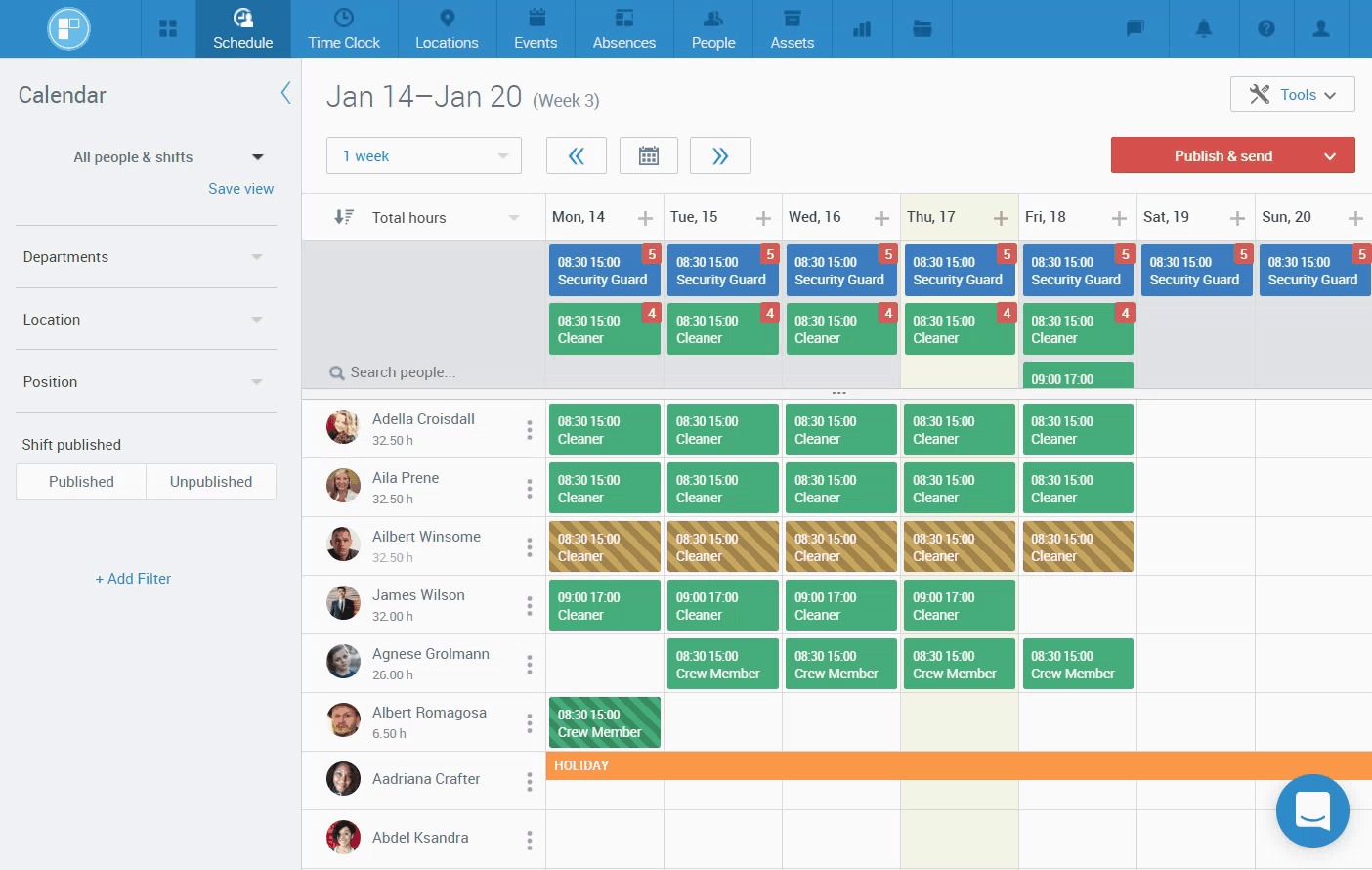
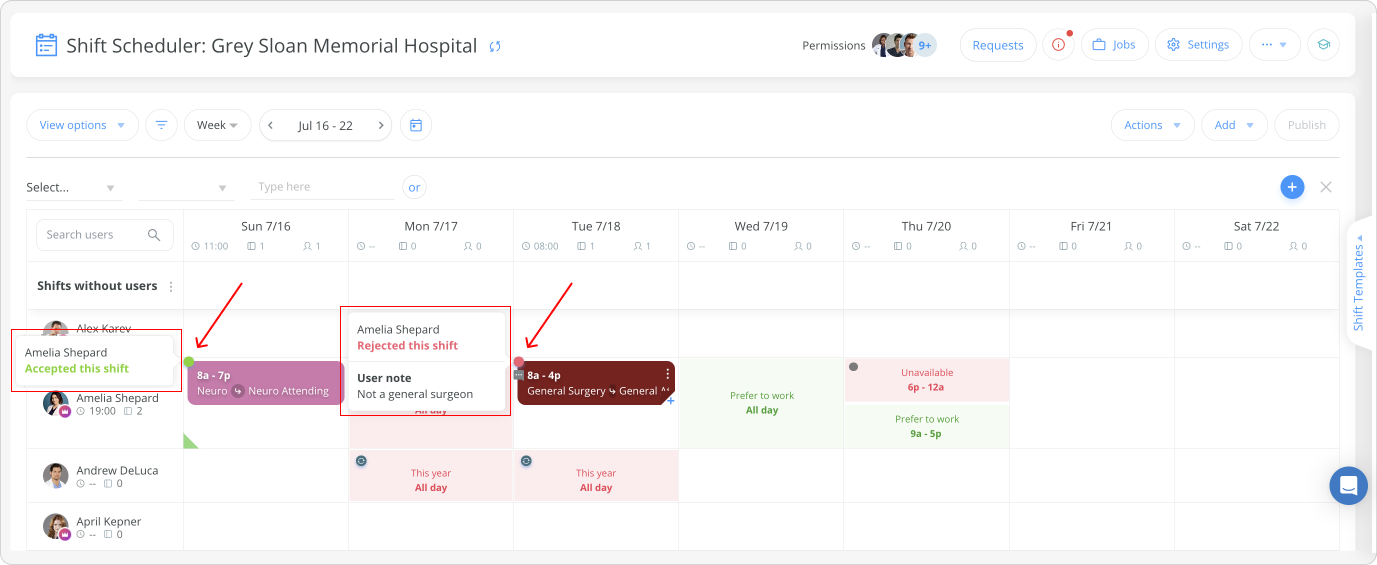
Both Parim and Connecteam offer flexible scheduling views, but they approach them differently. In Parim, managers can create custom calendar views using filters in the side panel and save unlimited personalised views. Connecteam, on the other hand, allows managers to create multiple schedules that function as separate scheduling views.
Each platform also includes a bulk selection mode, though the workflows differ. In Parim, multiple shifts can be selected in a single action by dragging across the calendar, making it quick to apply changes or copy shifts at scale. In Connecteam, shifts are selected individually, which offers greater precision but can be more time-consuming for larger schedules. Copying shifts is efficient in both systems: Parim allows users to copy up to an entire month at once using select mode, while Connecteam enables copying a full previous month or duplicating specific shifts through click-by-click selection.
One notable difference is shift importing. Connecteam supports Excel-based shift imports, which can significantly speed up initial setup or large schedule changes, while Parim is currently building this functionality. However, Parim offers a wider range of scheduling views, including two-week and three-month views, and allows managers to filter schedules by position, employment type, pay rate, qualifications, and more. Connecteam also includes automatic shift assignment, which can add agility to scheduling in certain scenarios.
In terms of time tracking, both platforms perform well. Each system provides real-time alerts to notify managers when shifts are confirmed or cancelled, or when staff fail to clock in as expected, helping teams respond quickly to coverage gaps and attendance issues.
Both platforms also support live location tracking, enabling organisations to capture GPS-based proof of presence when required. This is particularly valuable for mobile teams and field-based roles, giving managers greater confidence that staff are on site and on time.
Overall, both platforms deliver strong and reliable tools for shift scheduling and time tracking. Managers can create schedules, assign staff, and monitor worked hours, while employees can view shifts and clock in and out via mobile devices. For organisations with straightforward scheduling and attendance requirements, both systems perform equally well, resulting in a tie for this category.
Time clock apps: Winner – Tie
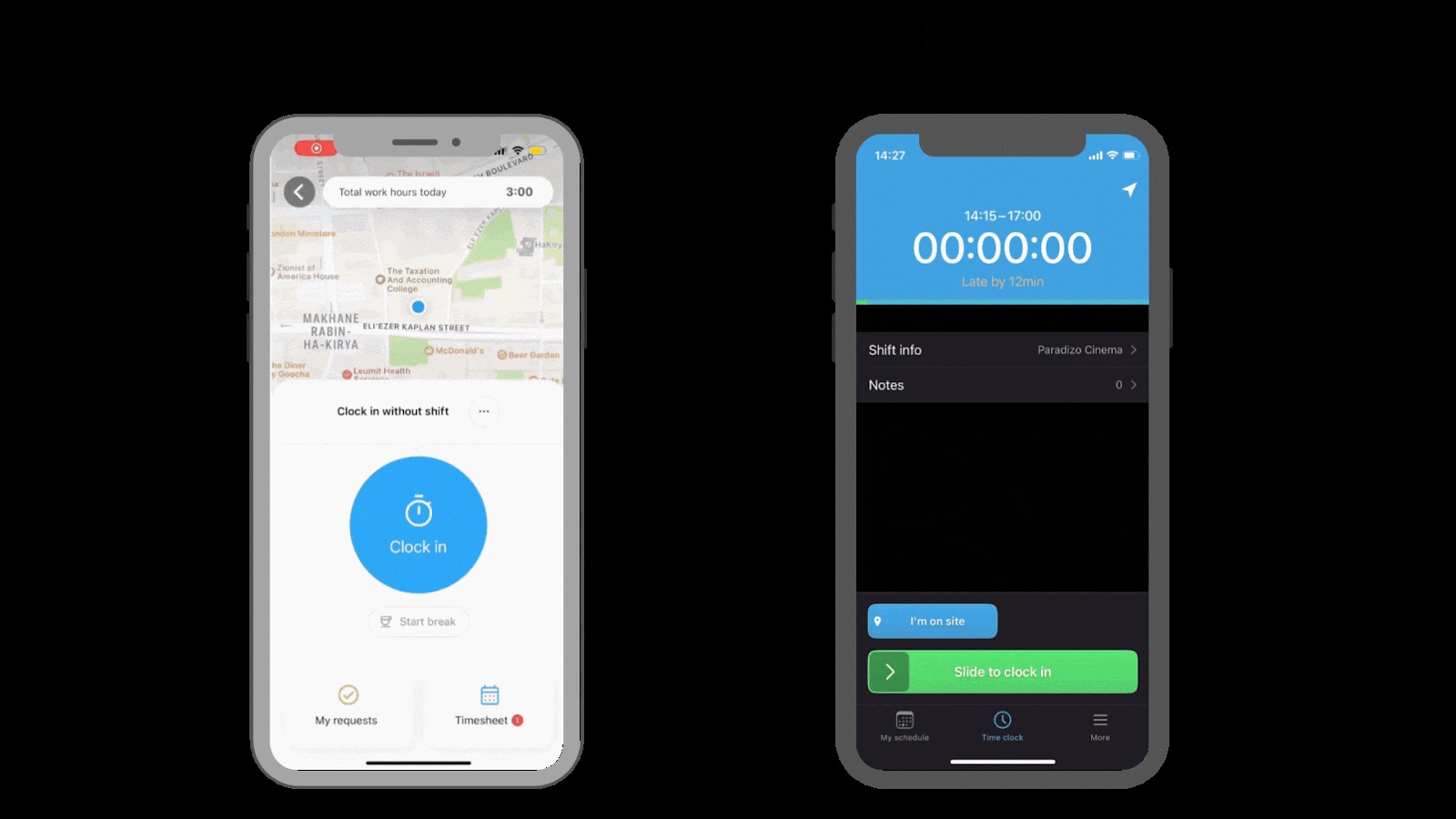
Both Parim and Connecteam offer robust mobile applications that support core time and attendance workflows. Employees can check in and out of shifts, access schedules, submit leave requests, report incidents, and complete patrol or site tours via NFC scanning. These shared capabilities allow field-based and mobile teams to operate efficiently without relying on desktop access.
Importantly, both platforms also provide mobile apps for managers, not just frontline staff — something many workforce tools lack. From a mobile device, admins can view schedules, confirm or cancel shifts, approve timesheets, and even manage scheduling on the go, adding flexibility for managers working in the field.
There are some differences in mobile depth. Connecteam offers additional mobile features, such as the ability to create forms and tasks directly within the app. It also allows staff to complete multiple forms, add signatures, and sign off on forms and clock-ins directly from their mobile device, which can be useful for internal workflows.
Parim, on the other hand, provides a dedicated mobile app for clients, enabling customers to stay informed and engaged while on the move — a valuable advantage for service-driven and security-focused operations. In addition, Parim’s native incident reporting is faster to complete than custom form-based approaches, as reports automatically link shift, site, and employee information, reducing manual input and improving accuracy.
Absence management – Winner: Tie
Both Parim and Connecteam provide strong, well-rounded tools for managing absences and paid time off. In both systems, employees can view their accrued holiday balances, request time off directly via the mobile app, and track the status of their requests. Managers receive instant notifications, and approved absences are automatically reflected in schedules and timesheets, reducing manual checks and administrative effort.
Both platforms also support advanced accrual rules, including accrual based on hours worked, carry-over limits, half-day logic, and holiday year configuration. These capabilities make them well suited for organisations with variable schedules, hourly workers, or complex leave policies where accuracy has a direct impact on payroll and compliance.
Overall, both platforms handle absence and PTO management effectively, whether requirements are simple or highly complex, making this category a tie.
Compliance – Winner: Tie
Both Parim and Connecteam include robust break management features that help organisations enforce compliance with labour regulations. Managers can define break rules based on shift length and receive alerts for missed breaks, with rules configurable to reflect local laws by day or week. Parim also allows age-based break rules, which can be important in regions with specific youth employment regulations.
Both platforms support automatic break deductions, ensuring that if an employee forgets to clock out for a meal break, the system adjusts the timesheet automatically. This reduces manual payroll corrections and helps maintain accurate time records.
Parim further extends compliance support with features such as qualification expiry tracking, maximum working-hour rules by employment type, and age-based pay rules aligned with legal requirements.
Both systems cover the core compliance needs most organisations require. As a result, this category is best considered a tie, with each platform meeting compliance requirements in slightly different ways.
Training and onboarding tools – Winner: Connecteam
Connecteam stands out when it comes to training and onboarding. It offers a comprehensive set of tools including customisable onboarding flows, digital forms, a built-in knowledge base, quizzes, courses, and acknowledgements. This allows organisations to standardise onboarding, reinforce policies, and track completion without relying on external tools.
These features are particularly valuable for organisations with high staff turnover or ongoing training requirements, such as healthcare or hospitality. While Parim supports basic onboarding through initial employee forms, Connecteam’s depth and structure make it the stronger choice for teams that prioritise learning and internal communication as part of onboarding.
Security–specific Features: Winner – Parim
Parim delivers a purpose-built set of security features for guarding, such as check calls, patrol tours, SIA badge checker (UK market), and built-in incident reporting, helping teams maintain oversight and respond quickly to on-site issues.
What sets Parim apart is how tightly these features are connected to live shifts and locations. Incidents are automatically linked to the active shift, site, and employee, improving accuracy and audit readiness. Combined with real-time visibility and operational controls, these tools help ensure accountability, compliance, and consistent service delivery, making Parim the clear winner for security operations.
Checklists and tasks: Winner – Connecteam
Connecteam offers a more advanced and flexible approach to tasks and checklists. Managers can create recurring or one-off tasks, assign them to individuals or teams, and track task completion in real time. This makes it easier to manage daily operational routines, quality checks, and internal processes without constant follow-ups or micromanagement.
While Parim does support task lists within shifts, these are more basic by comparison and are primarily designed to support operational execution rather than broader workflow management. For organisations that rely heavily on structured task management and clear visibility into task completion, Connecteam provides a clearer advantage.
Client & Subcontractor Management: Winner – Parim
Client and subcontractor management is an area where Parim clearly outperforms. It offers dedicated functionality for managing clients and subcontractors, including controlled access and a client portal with real-time visibility into schedules and operations.
Connecteam does not provide native client or subcontractor management. While schedules can be shared externally to third parties, clients cannot see information in real time or let clients approve timesheets.
For companies working with multiple clients, venues, or subcontracted staff, Parim’s built-in support improves transparency and strengthens client relationships, making it the clear winner in this category.
Overall, both Parim and Connecteam receive consistently strong user reviews across web platforms and mobile app stores. Users rate both highly for reliability, usability, and core workforce functionality.
Setup and Onboarding
Both Parim and Connecteam are designed to be quick to get started, with guided setup and self-service configuration. Core elements such as users, roles, schedules, and time tracking can be configured early, allowing teams to begin managing shifts and attendance without lengthy implementation.
The key difference lies in onboarding support. Parim offers more hands-on, live training delivered directly by the team, while still providing self-learning materials for independent setup. Live onboarding is available across all plans, whereas Connecteam primarily relies on self-education resources and offers live onboarding only to customers on higher-tier, Pro plans.
Support and Customer Service
Support Type
Parim
Connecteam
24/7 Chat Support
✅ Available
✅ Available
Phone Support
✅ Available
✅ Available (paid tiers via Connecteam Pros partners)
Email Support
✅ Available on all plans
✅ Available on free and paid tiers
Help Center & Documentation
✅ Comprehensive, operations-focused
✅ Extensive and well-structured
Live Onboarding & Training
✅ Available on all plans (hands-on, live training)
✅ Available on Pro plans (via certified partners)
Dedicated Account Manager
✅ Available (plan/organisation dependent)
✅ Available (paid support)
Both platforms provide reliable customer support and learning resources to help teams get the most out of the system. Users have access to help centres, documentation, webinar recordings, video instructions and support channels to resolve issues and learn how to use key features effectively.
Where they differ is in focus and depth. Connecteam leans heavily on self-service support, supported by extensive guides, videos, and in-app resources. Parim complements its documentation with live support, helping teams configure complex scheduling, workflows, and real-time operational use cases. For organisations with higher operational complexity, this hands-on, domain-specific support can be a key advantage.
Final Verdict: Parim or Connecteam?
Choose Parim if you…
Choose Connecteam if you…
Run physical security or live event operations that require real-time oversight
Need a simple general workforce system without any industry-specific requirements
Need security-specific features like check calls, guard tours, SIA badge checking, and native incident reporting
Prioritise onboarding, training, and internal communication
Manage clients and subcontractors and want a dedicated client portal
Don’t require client or subcontractor management
Require advanced scheduling flexibility, bulk actions, and complex pay & charge rules for clients
Prefer simple scheduling and pay management
Operate with large or fluctuating teams and want pricing that scales without per-user costs
Have a stable headcount and are comfortable with per-user pricing
Want hands-on onboarding and live training included across plans
Prefer self-service setup with extensive learning resources
Conclusion
Parim wins on security-specific functionality, operational depth, and support for complex, real-time field operations.
Connecteam wins on onboarding, training, internal communication, deeper HR management tools and ease of use for general workforce management.
The better option is the one that fits your operational reality, not just the feature list.
FAQs
Is Parim or Conncteam better for security teams?
Parim is generally better suited for security teams because it includes native security-specific features such as check calls, guard tours, SIA badge checking (UK), and integrated incident reporting, all designed for real-time field operations.
Is Parim or Conncteam better for live event teams?
Parim is the stronger choice for live event teams. Its scheduling flexibility, event and temporary project management, and client access features make it easier to coordinate staffing at scale for events and dynamic environments.
Which system can scale for growing teams?
Parim scales cost-effectively for larger and fluctuating teams thanks to its scheduled-hours pricing model and unlimited users (including both staff and admins). This makes it easier to grow headcount without costs increasing purely based on the number of users.
Connecteam, by contrast, does not scale as efficiently for large teams, as pricing increases with headcount. As a result, it can become significantly more expensive at scale, making it a better fit for smaller, agile teams with predictable workforce sizes.
Is Parim only for security and events teams?
No. While Parim offers advanced functionality for security and event operations, it is also a capable workforce management system for businesses in other industries. If you don’t need industry- or event-specific features, Parim’s flexible pricing allows you to exclude them from your plan so you’re not paying for tools you don’t use.
Parim still provides all the core workforce functionality many organisations need, including shift scheduling, PTO and absence management, compliance, time tracking, pay and charge management, and client management, making it well suited for general workforce use cases as well.
Is Connecteam better for small teams?
Connecteam’s predictable per-user pricing and straightforward scheduling tools make it a good fit for smaller teams with stable headcount. It also offers a free-forever plan for teams of up to 10 users, making it an accessible option for small businesses getting started.
Which platform should I choose in 2026?
The best choice always depends on your organisation’s priorities:
Choose Parim if your operational needs include real-time field visibility, security-focused workflows, advanced scheduling, and client/subcontractor management.
Choose Connecteam if you prioritise onboarding, training, internal communication, and broad HR and workforce coordination across more general use cases.
Is Parim or Connecteam better for bigger teams?
For larger and more complex teams, Parim often offers better value due to its flexible pricing model that isn’t tied to headcount. This makes it particularly cost-effective for organisations with large or fluctuating teams. However, the best choice still depends on the functionality your business requires.
If your organisation operates in industries such as temporary workforce staffing or healthcare, requires HIPAA compliance, or places a strong emphasis on HR processes and employee engagement, Connecteam may be the better fit. Its strengths lie in areas like training, engagement, and internal communication.
On the other hand, if your team does not benefit from features such as rewards, advanced task management, company celebrations, recognition tools, or multiple customisable forms, Parim can deliver better value for money by focusing on core workforce and operational functionality without unnecessary extras.