Parim vs. Timegate: which workforce management software is better for your security team?
Both Parim and Timegate (TEAM Software) are workforce management platforms designed to help security teams schedule staff, track time and pay, and maintain compliance. While the two systems share many core capabilities, they also differ in functionality, focus, and overall approach. Let’s take a closer look at those differences.
How we evaluated: Our product comparisons and conclusions are informed by hands-on testing carried out by our experienced team.
Quick Overview
Parim is a modern, cloud-based workforce management platform designed for usability and flexibility. It offers core functionality such as scheduling, pay and charge rates, absence tracking, and full client management. In addition, it includes security-specific features like check calls, guard tours, incident reporting, asset tracking, daily SIA checker, and event scheduling, making it well-suited for security teams supporting events.
Timegate is an established workforce management system used by security organisations with complex operational structures and higher compliance requirements. It provides core workforce capabilities such as scheduling, pay management, and reporting, alongside security-specific features including check calls, guard tours, and incident reporting.
Parim
Timegate
Pricing model
Flexible per-scheduled-hours pricing with unlimited users; plans start at £47/month for basic features, £119/month for Pro, and £299/month for Premium
Usually customisable. Example: £850 for 100 users. Agreements are often multi-year commitments and may be harder to exit. (User-reported, Jan 2026)
Unlimited users
Yes, unlimited free users included in all plans (Capterra)
Not typically, user-based licence structures more common (based on user input)
Billing approach
Based on hours scheduled, not per user
Per user (example: 100 users at set fee)
Onboarding cost
Free
Paid with longer implementation
Contract flexibility
Monthly and annual plans available
Longer, multi-year commitments common (user-reported)
Free trial
Standard trial options available (e.g., free 14-day trial) (Parim)
Free demos available; pricing typically directly with vendor (no public free trial noted) (SoftwareAdvice)
Target customer
Broad range, including events and security teams
Larger security organisations with more complex structures
Parim’s pricing is designed to be flexible and scalable. Instead of charging per user, it’s based on scheduled hours and includes unlimited users, admins and sites across all plans, which can make costs easier to control as teams grow. For many security and event teams, this model offers good value, especially when you need a broad set of features, scheduling, compliance tools, modern mobile apps, events management, and integrations – all without paying extra for each additional staff member. Free onboarding and shorter commitments also reduce upfront risk.
Timegate follows a more traditional enterprise pricing approach. Based on user-reported figures, pricing is typically set per number of users and often tied to multi-year contracts, with paid onboarding. This can work well for very large organisations with stable headcountand predictable revenue. However, for teams that want flexibility or expect to scale up and down during certain seasons, the total cost of ownership can be higher.
Pros and Cons
Both platforms are powerful workforce management tools for security businesses, but they’re built with different approaches.
Parim pros ✅
Modern, all-in-one platform for security and events: Agile and modern scheduling, payroll, strong client management, time & attendance, incidents, patrols, assets, and event workflows all live in one system. Perfect option for teams that want clarity without juggling multiple tools.
Strong mobile experience: Parim’s mobile apps are consistently highly rated, making it easier for guards to adopt the system and actually use it day to day.
Fast onboarding and flexible pricing: Free onboarding, unlimited users, and pricing based on scheduled hours make it easier to scale without committing to long contracts.
Parim cons ❌
Slightly less granular payroll configuration: Teams with extremely complex pay logic may need additional setup or external payroll tools.
Fewer legacy compliance edge cases: Some very specific enterprise workflows may require configuration rather than being available out of the box.
Timegate (TEAM Software) pros ✅
Legacy enterprise system: Timegate offers high customisation across pay, billing, and compliance, which can be valuable for large organisations with complex structures.
Advanced pay and billing rules: Multiple hour types, pay levels, premiums, overtime rules, and site budgets give finance teams fine-grained control.
Strong compliance tooling: Features like document expiry tracking, e-signatures, audits, guard tour escalations, and incident workflows support regulated security operations.
Timegate cons ❌
Outdated and complex user experience: The interface is often described as slow and difficult to navigate, with a steeper learning curve for admins and staff.
System performance & errors: Some users report that the system can feel slow, along with occasional errors.
Weak mobile and event support: The staff app has low ratings, limited functionality, and there’s no mobile app for clients and admins.
Less flexibility in pricing and contracts: User-reported pricing suggests higher costs, paid onboarding, and multi-year agreements that can be difficult to exit.
Use Cases
Parim is best for:
Teams that want speed and simplicity: Faster setup, clearer workflows, and modern UX help teams become productive quickly.
Security teams covering events: Built-in event scheduling, asset tracking, and strong mobile apps for staff, clients and admins make it well suited for dynamic, short-term deployments.
Mobile-first operations: Guards can manage shifts, check calls, patrols, incidents, and tasks easily from their phones, improving data quality and adoption.
Timegate is best for:
Security organisations with formalised operations: Especially those operating under long-term contracts, with predictable revenue and headcount, and heightened pay and compliance requirements.
Highly customised payroll and billing: Organisations that need detailed control over pay logic, premiums, and budgeting across multiple sites.
Compliance-heavy environments: Where extensive audits, document controls, and layered workflows are a priority.
Parim vs Timegate: Core Features Compared
Both platforms address core workforce needs, but the difference lies in how effectively those features work in real-world security operations.
Staff scheduling, time & attendance – Winner: Tie
Timegate places a strong emphasis on team flexibility. It supports shift swaps, duty giveaways, and shift splitting, which can be particularly useful when urgent cover is required.
Both systems support shift patterns that can be customised to specific operational needs.
A key differentiator is Timegate’s ability to assign task-based actions to shifts, such as document uploads or form completion, whereas Parim offers a simpler, more streamlined approach to task management.
While event scheduling is supported, it lacks a clear calendar-style view, making complex or multi-day schedules harder to visualise. Overall, despite its strong collaborative capabilities, the core scheduling tools seem outdated and may require more time to build and adjust schedules compared to more modern interfaces like Parim’s.
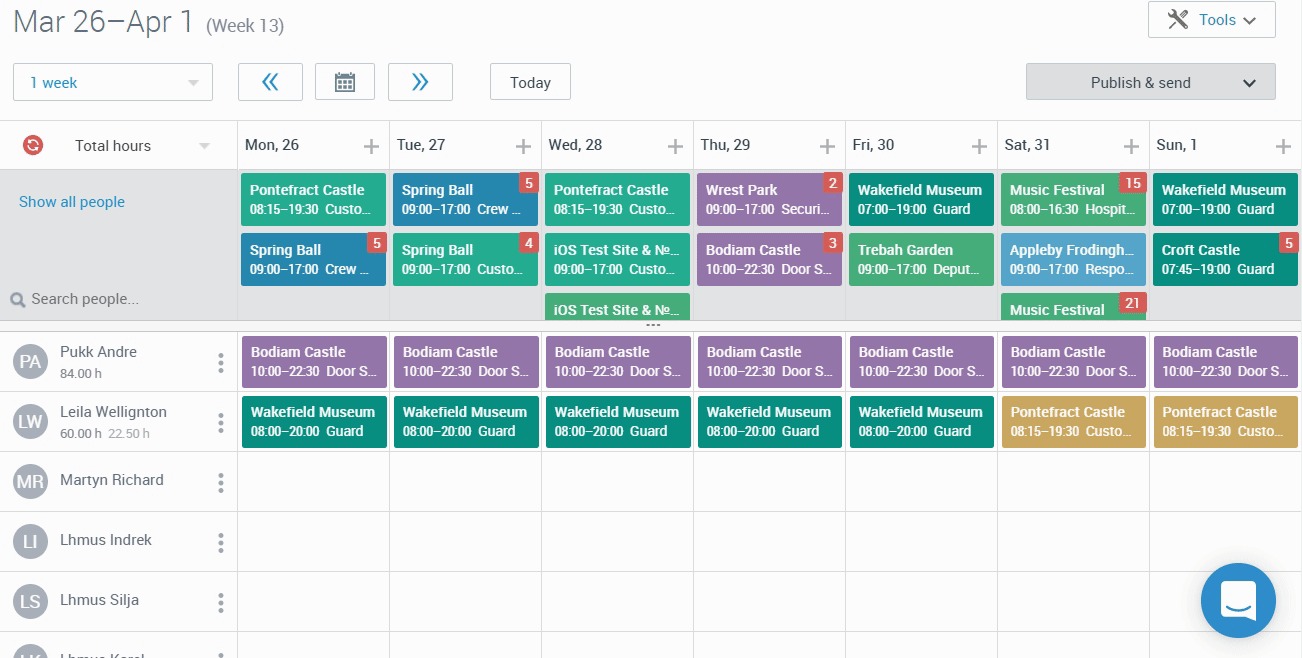
Parim approaches scheduling with a strong focus on clarity and speed for admins. Its scheduling interface is more visual and intuitive, using multiple colour statuses to clearly show coverage, gaps, and changes at a glance. Admins can easily copy, move, or adjust shifts using selection modes, making it quicker to respond to last-minute changes. As a result, the overall scheduling view is easier to process, helping teams understand shift coverage and staffing status instantly.
Both platforms offer a comparable set of core scheduling controls, including break rules, minimum and maximum working hours, shift assignment logic, and cancellation rules.
In terms of time and attendance, both platforms perform strongly. Each system provides real-time alerts to notify managers when a shift is cancelled or a guard fails to clock in.
Live location tracking is also available in both systems, allowing teams to capture GPS-based proof of presence when required.
Overall, both Parim and Timegate cover essential scheduling and attendance needs effectively, excelling in different areas depending on team priorities.
Mobile apps: Winner – Tie
When it comes to mobile apps, both Parim and Timegate offer functionality that allows staff to clock in and out, view schedules, submit absence requests, raise incidents, and complete guard tours on the go. Both platforms support core mobile workflows that enable field teams to manage their day-to-day tasks remotely.
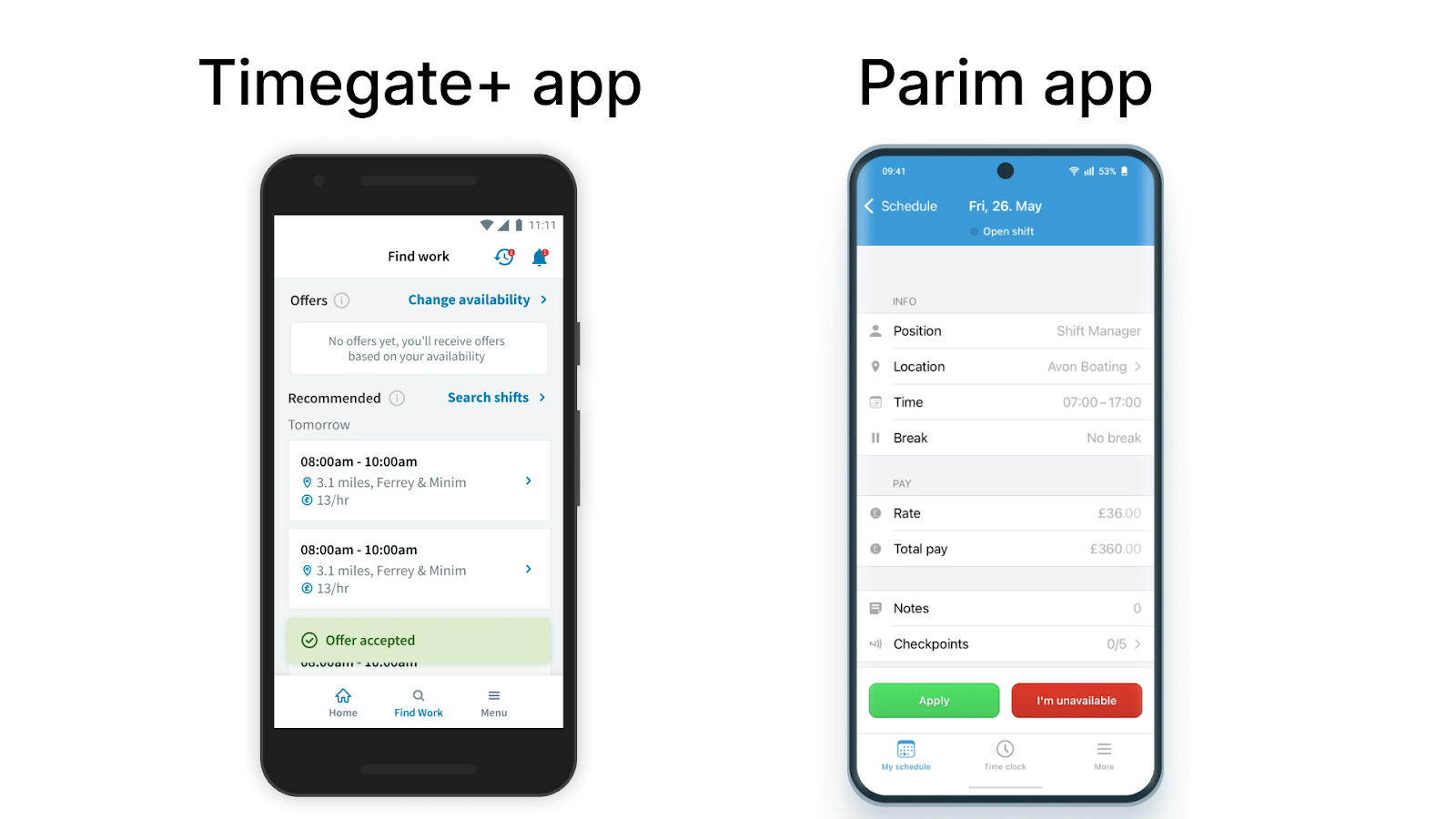
Parim’s mobile apps are designed with day-to-day usability in mind, supporting not only staff but also managers and clients. Users can view schedules, confirm shifts or timesheets, and even manage scheduling directly from a phone or tablet through a modern, intuitive interface that is consistently getting high scores. Parim also provides real-time visibility into attendance and workforce data, which is particularly valuable for mobile and event-based teams that need instant operational insight while on the move.
Timegate also provides a mobile app that gives staff quick access to shifts and time tracking from their devices. However, unlike Parim, Timegate does not offer dedicated mobile apps for managers or clients, with those roles limited to desktop access. On the positive side, Timegate supports additional custom forms and audits that staff can complete during shifts, which can be important for certain operational or compliance workflows. While Timegate’s app covers essential field tasks, user reviews indicate less consistent performance and usability compared to Parim.
Despite these differences, both platforms deliver similar core mobile functionality overall, making this category a tie that largely comes down to user preference and real-world performance.
Compliance: Winner – Timegate
When it comes to compliance, Timegate takes a more extensive and configurable approach. As an established workforce management system designed for structured operations, Timegate includes features such as alerts for expired qualifications, document expiry tracking, e-signatures for contracts and forms, and site budget controls to help prevent overspending. These tools are particularly valuable for organisations that require strict control over service levels, strong adherence to contractual obligations, and detailed compliance reporting across multiple teams and locations.
Parim also supports key compliance workflows, including qualification expiry tracking, maximum working hour rules for different employment types, and pay rules based on age and other legal requirements. These features cover the core compliance needs for most security teams and help ensure adherence to common regulatory standards.
However, Timegate offers more built-in compliance frameworks, with more advanced reporting, escalation rules for missed checks-ins and tours, and highly configurable compliance controls. As a result, Timegate edges ahead in this category, particularly for organisations where compliance oversight and governance are central operational priorities.
Security–specific Features: Winner – Tie
Both Parim and Timegate provide a strong set of security-focused features that cover the core needs of guarding operations. Each platform supports check calls, guard tours, and incident reporting, enabling teams to monitor activity and respond quickly to issues on site. These tools help ensure visibility, accountability, and consistent service delivery across security teams.
The difference lies in the specific functionality each platform emphasises. Parim offers an automated SIA badge checker for UK companies, helping security teams stay compliant with licensing requirements, while Timegate provides more layered escalation workflows for missed check calls and incomplete tours.
Ultimately, both systems meet essential security requirements effectively, making this category a tie.
Integrations: Winner – Parim
Parim offers a broader and more modern range of integrations, making it easier for teams to connect workforce data with popular accounting systems such as Intuit QuickBooks, Sage Intacct, Xero, and Zoho Books, as well as HR systems including BambooHR, Breathe HR, Sage HR, Oracle, Zoho People, and others. This flexibility is particularly valuable for organisations that rely on multiple tools across finance and HR, as it reduces the need for manual exports and duplicate data entry.
Timegate primarily integrates with other TEAM Software products, such as TemplaCMS and PDC (applicant portal), alongside a small number of third-party systems including Sage Payroll, PASS, Checkr, and Orka. While integrations like PASS and Sage are relevant for UK security companies, others such as Checkr and Orka are less applicable in the UK market, limiting their practical value for many teams.
As a result, Parim takes the lead for organisations looking for faster, more flexible system connectivity and a wider integration ecosystem beyond a single vendor’s product suite.
Overall UI & Speed: Winner – Parim
Parim stands out with a modern, cloud-based interface that is intuitive and easy to navigate for both admins and staff. Key workflows such as scheduling, time tracking, and incident management are designed to be visual and fast, with real-time updates and clear status indicators that make it easier to understand what’s happening at a glance.
Timegate, by contrast, uses a more traditional and complex interface that many users describe as slower and harder to navigate. While highly configurable, the system often requires more clicks and time to complete common tasks. In day-to-day use, Parim delivers a noticeably smoother and more responsive experience.
Note: Timegate currently has only a small number of reviews on these platforms, so the available ratings should be interpreted with caution and are not broadly representative.
Parim’s mobile apps receive consistently strong ratings across both app stores, backed by a large number of reviews, which indicates high user satisfaction and reliable performance.
Timegate+, by contrast, has lower ratings and a much smaller review base, suggesting a more mixed user experience.
Overall, user feedback clearly favours Parim in terms of mobile app quality and usability.
Setup and Onboarding
Parim is designed for quick adoption, with free onboarding and a relatively short time to value. Most teams are able to get up and running within weeks, supported by a straightforward setup process and clear interface.
Timegate typically involves a longer and more complex implementation with paid onboarding and configuration. While this allows for deep customisation, it also means a steeper learning curve and longer time before teams become fully productive.
Support and Customer Service
Parim focuses on responsive, modern customer support, with onboarding assistance and ongoing help designed to enable teams to quickly self-manage workflows. Support is generally seen as accessible and well aligned with fast-moving operational teams. Notably, Parim reports a customer satisfaction score of over 90% over the years, which reflects a consistently high level of support quality for a software platform.
Timegate provides enterprise-style support suited to more complex implementations, but this can feel more formal and slower-paced. For organisations with dedicated system administrators, this approach may work well, while smaller or more agile teams may find Parim’s support model more approachable and easier to engage with.
Final Verdict: Parim or Timegate?
Choose Parim if you…
Want a modern, intuitive platformthat’s quick to adopt and easy for both admins and guards to use.
Need strong scheduling, asset tracking, and flexible workflows for dynamic operations.
Rely on mobile-first operations and want high-quality apps for staff, managers, and clients.
Want broad integrations with HR and accounting systems like Xero, QuickBooks, Sage Intacct, BambooHR, etc.
Prefer flexible pricing with unlimited users and fast, free onboarding.
Need fast visibility, real-time scheduling, and a system that scales easily with growth.
Choose Timegate if you…
Prefer a configurable enterprise system and are comfortable with a steeper learning curve.
Operate mostly with complex organisational setups.
Work mainly with desktop-based admins and only need a mobile app for staff.
Are already embedded in the TEAM Software ecosystem (PASS, PDC, Templa) and plan to stay within it.
Are comfortable with multi-year contracts, paid onboarding, and per-user pricing.
Need deep payroll logic, complex compliance frameworks, and detailed enterprise reporting.
Conclusion:
Parim wins on usability, speed, mobility, and flexibility. Timegate wins on configurability, compliance depth, and enterprise control.
Ultimately, the “best” platform depends on your specific operational needs
FAQs
Is Parim or Timegate better for event security teams? Parim is generally better suited for event-based operations due to its event scheduling and mobile-first design.
Does Timegate offer more advanced compliance features? Yes. Timegate provides deeper compliance frameworks, including document management, and escalation rules.
Which platform is easier to use? Parim is widely considered easier to use, with a more intuitive interface and better mobile experience.
Can both systems scale for growing teams? Yes, both can scale, but Parim offers more flexibility through its pricing model and unlimited users, making growth easier to manage.
Is Parim a good alternative to Timegate for large enterprise companies? Yes. Parim is often chosen as a modern alternative to Timegate, especially by teams looking for better usability, stronger mobile apps, faster onboarding, and more flexible pricing.
Is Timegate only for large enterprises? No, but it is most commonly used by organisations with structured operations, complex pay rules, and strong compliance requirements. Timegate contracts are typically multi-year and can be difficult to exit, which may be a consideration for smaller businesses that prefer more flexibility.
Which platform is better for multi-site operations? Both support multi-site operations, but Parim offers clearer real-time visibility and easier cross-site scheduling, especially for security teams that cover events.
Does Timegate require long-term contracts?
Timegate is often sold with multi-year agreements, while Parim offers more flexible contract options.
Which platform should I choose in 2026?
For most security and event teams, Parim is the better choice due to its modern UX, strong mobile apps, faster onboarding, and flexible pricing. Timegate remains a strong option for organisations that prioritise deep configurability and compliance over ease of use.